For most parents, the word “playground” brings a very specific image to mind: a stretch of tarmac or rubber matting, a climbing frame and twenty minutes for children to run off some energy before the next lesson begins. It is where breaktime happens, not where learning happens. That assumption is understandable. For generations, the space outside the classroom door has been treated as separate from the space inside it, one for lessons, the other for letting off steam.
In schools that take outdoor learning seriously, however, that same stretch of ground is being asked to do something quite different. A flower bed becomes a maths lesson in counting and measuring. A patch of shade becomes a reading corner. A puddle becomes the starting point for a conversation about evaporation. None of this requires an elaborate campus. It requires a shift in how the space is used, and a willingness to treat it as part of the curriculum rather than a break from it.
This article looks at what that shift actually involves: what outdoor learning means in practice, why it suits younger children so well and how a school can tell the difference between an outdoor space that is genuinely educational and one that is simply decorative. Along the way, it looks at gardening, nature play, physical development, social and emotional growth and how outdoor learning changes shape as children move from the early years into primary and secondary school.
It also considers what this looks like for schools operating in a hot, humid climate such as Bangkok’s, where a good outdoor learning space has to work with the weather rather than against it.
What do we actually mean by “outdoor learning”?
“Outdoor learning” gets used as a catch-all phrase, but it covers several quite different activities, and it helps to separate them out.
There is outdoor recreation: free play, sport and the unstructured breaktime most parents remember from their own schooldays. This matters for fitness and for giving children a breather, but it is not built around a particular learning goal.
There are structured outdoor lessons: a science observation, a maths measurement task or a writing exercise that has been deliberately moved outside because the setting adds something a classroom cannot offer.
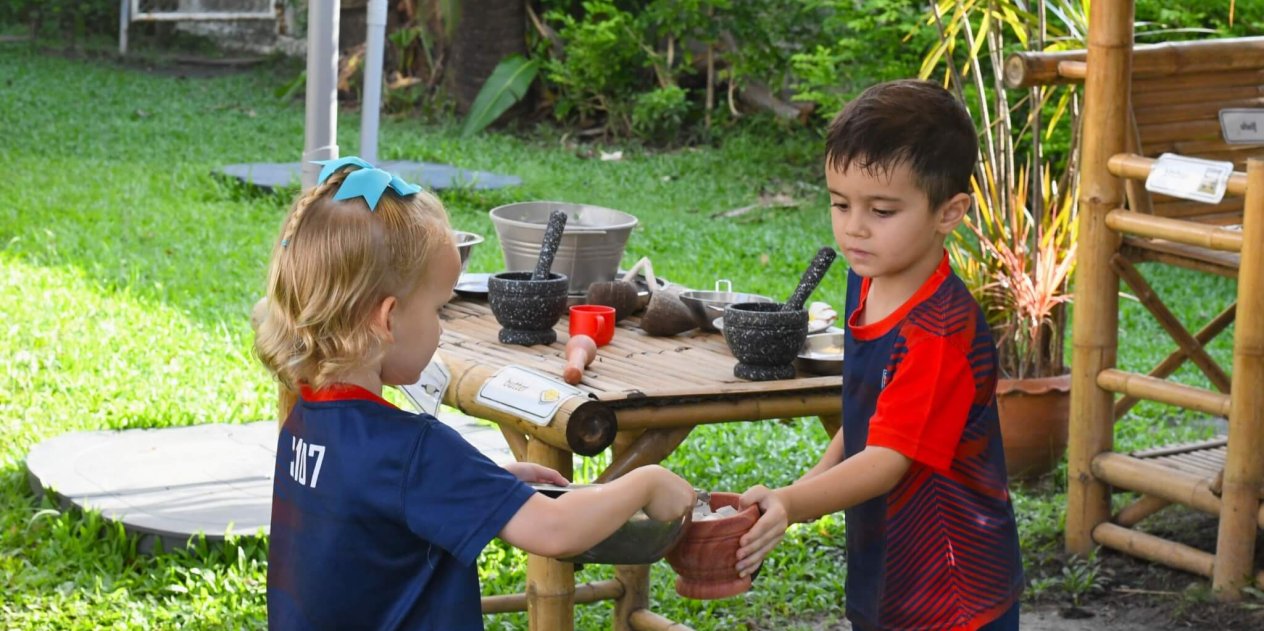
There is nature play: open-ended, child-led exploration using natural materials such as sticks, stones, water and mud, where children decide what to do with what they find rather than following instructions.
There is garden-based learning: ongoing projects involving planting, tending and harvesting, which tend to draw together biology, nutrition and a sense of responsibility.
There are outdoor classrooms: dedicated teaching spaces outside, which might be as simple as a circle of logs under a tree or as elaborate as a purpose-built shaded structure.
And there is environmental education: direct teaching about ecosystems, sustainability and how human activity affects the natural world.
Early years and nature-based education organisations increasingly frame this whole field as children’s regular, active engagement with the natural world as part of how they learn, distinct from the occasional outdoor break. That distinction is worth holding onto, because outdoor learning is not only a science topic or an environmental one. Done well, it touches social and emotional growth, language development, mathematics and art just as directly as it touches biology. The IUCN’s explainer on nature-based education describes it in similar terms: an approach that weaves environmental and experiential learning across the curriculum rather than confining it to one subject.
Why younger children take to outdoor learning so readily
Young children do not learn primarily by sitting still and listening. They learn by moving, touching, watching, repeating and imagining, often all at once. This is not a preference schools have to work around; it is close to how early childhood development actually works, which is why frameworks such as the Early Years Foundation Stage (EYFS), used in our Early Years Centre and in British international schools worldwide, expect providers to balance indoor and outdoor experience rather than treating outdoor time as optional.
Part of the reason outdoor spaces suit this style of learning so well is simply that they are less predictable than a classroom. A worksheet has a right answer built into it. A puddle does not. A child working out whether a stick will hold their weight, or why one leaf floats and another sinks, has to observe, test an idea and adjust, which is a slower and messier process than following a set of instructions, but it is also a more active one.
Early Education, a UK early years membership organisation, describes children as “innately curious, driven learners” who do some of their best learning when they are given room to investigate the world first-hand, and notes that being outside for extended periods has been linked with gains in physical coordination, sensory development and cognitive skills, each developing at a child’s own pace.
There is a social dimension too. With more space and fewer fixed rules about where to stand or what to touch, children often find it easier to negotiate who goes first, share out a task or settle a small disagreement without an adult stepping in immediately. That is not to say collaboration cannot happen indoors, but the openness of an outdoor space tends to give children more room to work these things out for themselves.
Outdoor classrooms: when moving the lesson outside is worth it
An outdoor classroom is not simply a normal lesson delivered somewhere sunnier. If a maths lesson could just as easily happen at a desk, moving it outside for the sake of a change of scenery does not make it more educational, only more pleasant. The cases where it genuinely adds value are the ones where the setting changes the quality of the learning itself.
Reading a story under a tree is a small example, but a real one: children hear background birdsong, feel the texture of bark or grass and associate the story with a sensory experience rather than four walls. Sketching an actual leaf, rather than a photograph of one in a textbook, forces closer observation of its veins, its edges and the way light passes through it.
Measuring the length of shadows at different times of day turns an abstract idea about the sun’s movement into something a child can watch happen. A class discussion held somewhere more open sometimes draws out contributions from children who are quieter indoors, simply because the setting feels less formal.
The common thread is intention. A lesson belongs outside when the environment offers something specific: a live example, a sensory detail, real measurements or a different kind of participation. When that reason is missing, the activity risks becoming a pleasant walk rather than a lesson, which is a fine thing in its own right but is not the same as outdoor learning.
Garden-based learning: growing more than plants
Few outdoor activities touch as many parts of a child’s development as gardening does. Reviews of school garden programmes have generally found positive results, with several studies reporting gains in science-related knowledge among children who took part in structured garden-based teaching compared with classroom instruction alone. The likely explanation is straightforward: growing something makes biology tangible. A child who has watched a bean seed split, sprout and climb a cane understands germination in a way that a diagram cannot fully convey.
Gardens also change children’s relationship with food, though the evidence here deserves a careful reading. A systematic review of 35 school garden programmes, covering more than 25,000 children across twelve countries, found consistent gains in nutritional knowledge and in children’s attitudes and willingness to try vegetables. Effects on how much children actually ate were far less clear cut, with most studies showing no significant change in overall fruit and vegetable intake.
What does come through reliably is willingness. Children who have grown something tend to be more open to tasting it, and the sequence of planting a seed, watering it, waiting and eventually harvesting something edible teaches patience and cause and effect in a way that is hard to replicate through explanation alone. A child who has waited eight weeks for a carrot to be ready understands delayed reward in their bones, not just in theory.
There is a social and emotional layer here as well. Several qualitative studies from different countries have found that school garden programmes are consistently associated with stronger social and emotional skills and a greater sense of connection to the natural world, and for children with additional needs, gardening has also been linked with gains in non-verbal communication and cooperative behaviour. Put simply, a garden is a science lesson, a maths exercise in measuring and predicting, a lesson in nutrition and a team project, often within the same afternoon. Few single resources touch that many parts of the curriculum at once.
Nature play and the value of open-ended materials
Loose natural materials behave very differently from most playground equipment. A slide has one obvious use. A stick does not: it might become a wand, a fishing rod, a measuring tool or the wall of an imaginary den, depending entirely on what a child decides to make of it. Logs, stones, sand, water, leaves and branches all share this quality. There is no single correct way to use them, which is precisely what makes them valuable.
This kind of open-ended material is particularly good at supporting imaginative play, because it puts the child in charge of deciding what something becomes rather than asking them to use an object the way it was designed to be used. A wooden train tends to suggest a narrower range of uses. A stick can become almost anything, and a child moving between those possibilities is doing genuine creative and problem-solving work, even if it looks, from the outside, like simply playing with a stick.
None of this means adults should stand back entirely. Early years practice suggests that the strongest outcomes come when attentive adults notice what has caught a child’s interest and gently extend it at the right moment, perhaps by asking a question or offering a related material, rather than directing the play from the start. The adult’s role is to support the exploration, not to script it.
Physical development and the value of manageable risk
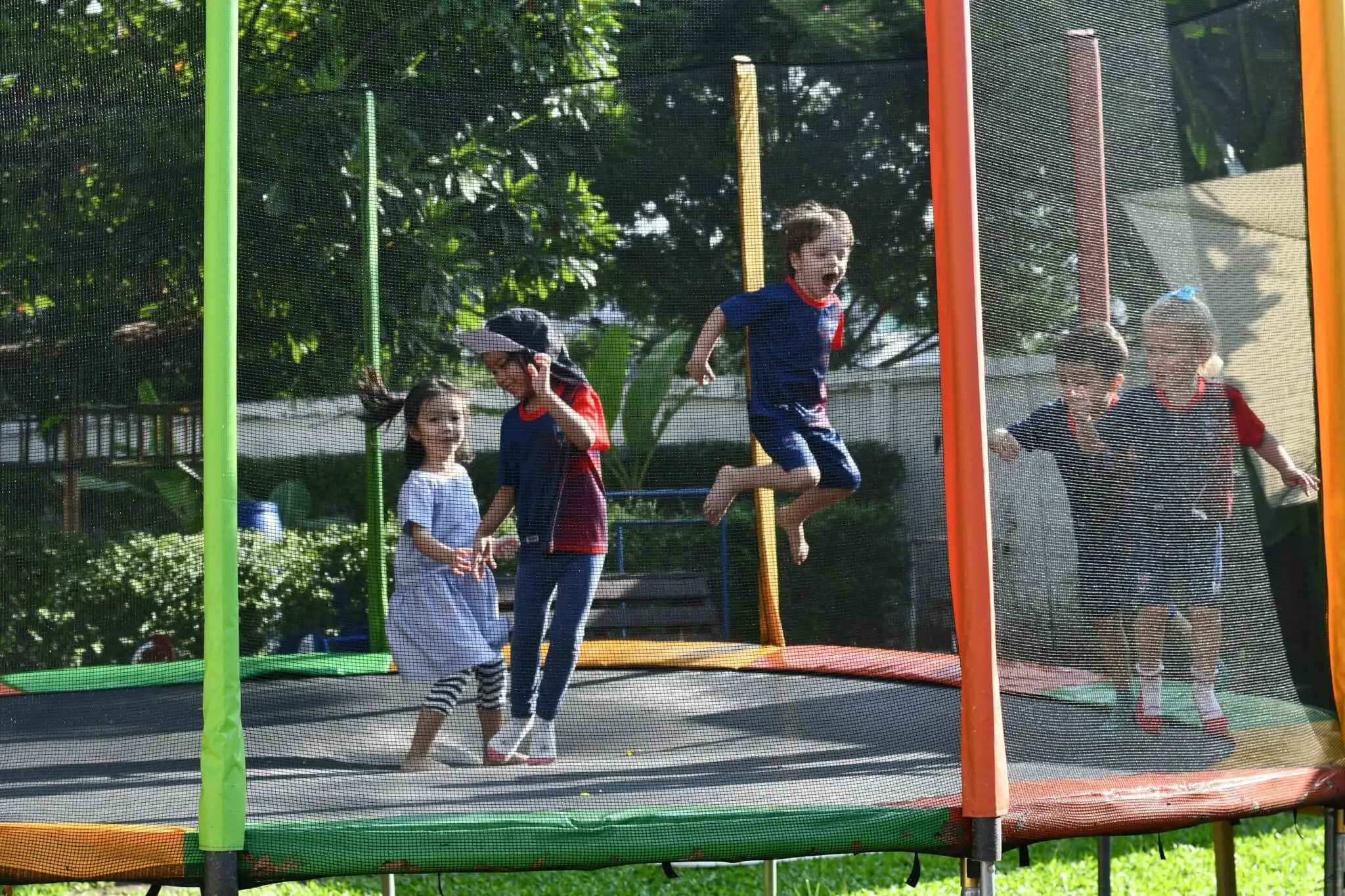
Outdoor spaces naturally invite children to balance on uneven ground, climb, dig, carry and judge distances, movements that are genuinely difficult to recreate indoors. These are not incidental extras. Building core strength and shoulder stability through this kind of movement is often identified as laying the groundwork for later fine motor skills, including handwriting, since a child needs a stable trunk and shoulder before their hand can produce controlled, legible marks.
Within this, there is a more specific and carefully researched idea worth explaining properly, because it can sound alarming if it is not: “risky play.” This does not mean carelessness or unsafe equipment. It refers to physical play that involves genuine but manageable uncertainty, the kind of thrilling feeling a child gets from climbing slightly higher than they have before, balancing along the edge of something or moving at speed.
Professor Ellen Sandseter, whose research has shaped much of the current understanding of this area, distinguishes clearly between danger, which should always be minimised, and risk, which children actively seek out and are capable of assessing for themselves within limits.
Sandseter’s work suggests that this kind of play may support children’s ability to judge risk, build physical competence and confidence, and even have what she describes, in her more recent research, as an anti-phobic effect, meaning that children who have had the chance to test their limits in a controlled way, and occasionally experience a scare or a minor tumble, appear to develop into adults who are less prone to related anxieties. As she puts it in one interview, children experience this kind of play as “scary, funny or fearful joy”, an almost exhilarating combination that seems to build both confidence and self-regulation over time.
This is worth parents holding onto, because the instinct to remove every possible source of risk from a child’s environment is understandable but can be counterproductive. Sandseter’s research indicates that a lack of opportunities for this kind of play, and for making independent decisions more generally, is associated with higher anxiety levels in some children. The aim of good outdoor design, then, is not to eliminate risk altogether but to manage it carefully, so that children can climb a little higher or balance a little further under conditions that are genuinely safe, while still getting the benefit of testing themselves.
Social and emotional development outdoors
Outdoor spaces tend to give children more room, in every sense, to work through social situations on their own. With fewer physical constraints and less need for an adult to referee every interaction, children are more likely to negotiate the rules of a game, sort out who does what in a shared task or resolve small disputes with a degree of independence that is harder to achieve in a busy classroom. Early years practitioners often link this kind of unsupervised negotiation with gains in confidence, empathy and self-regulation, simply because children get more practice at handling these situations themselves.
At the same time, a well-designed outdoor space can also offer something gentler: a quiet corner away from the noise and pace of a full classroom, where a child who needs a moment to themselves can observe rather than participate. That kind of space supports emotional regulation in a different way, by giving children permission to step back when they need to rather than requiring constant engagement.
There is a broader pattern in the research here too. Outdoor play has been associated with reduced anxiety and improved self-esteem in several studies, and UNICEF notes that a growing body of evidence points to better physical, mental and emotional health among children who get regular time outdoors. As with most research in this area, these are associations rather than guarantees, but the pattern is consistent enough to take seriously.
How outdoor experience feeds into the wider curriculum
The clearest way to judge whether an outdoor space is genuinely educational, rather than simply a pleasant place to spend break time, is to look at how directly it connects to what children are actually learning. Done well, outdoor time can support:
- Counting and sorting natural objects such as seeds, leaves or stones during early mathematics
- Measuring and recording plant growth, rainfall or temperature over several weeks
- Spotting patterns, shapes and symmetry in leaves, shells or flowers
- Writing detailed descriptions based on what a child can see, hear, smell and touch, rather than imagination alone
- Using simple maps or directions during an outdoor investigation
- Studying a real habitat or food chain rather than a diagram in a textbook
- Producing artwork inspired directly by natural textures, colours and forms
- Investigating shadows, light and basic physics using the sun and the surrounding environment
None of this happens automatically just because children are outside. When a lesson is moved outdoors without a clear reason connected to what is being taught, it tends to drift into recreation, however enjoyable that might be. The strongest outdoor programmes make the curricular link explicit, so children (and their teachers) understand why a particular activity is happening outside rather than at a desk. In practice this means outdoor work should sit inside the school’s curriculum planning, not alongside it as an optional extra.
What makes an outdoor learning environment work well
Turning outdoor space into a genuine learning environment takes deliberate design, not just good intentions. Early years guidance consistently points to a similar set of features, used in combination: flexible areas for gathering and group teaching, dedicated planting zones, shaded seating, sensory areas that involve touch, smell and sound, water and sand for exploration, a ready supply of loose natural materials such as logs and stones, spaces built for climbing and balancing, quieter corners for reflection, small habitats that attract insects or birds and storage that is easy for children to reach so that resources can be used spontaneously rather than only during a planned activity.
None of this requires an extensive campus. A single well-stocked planting bed, a shaded gathering circle and a box of loose materials can support a surprising amount of meaningful learning if they are used with intention and regularity. The scale of the space matters far less than how consistently it is woven into everyday teaching.
Designing for Bangkok’s climate
For any international school operating in a tropical climate, outdoor learning space has to be designed around the weather, not just around pedagogy. A few practical considerations come up again and again in guidance on this topic.
Shade matters more than it might seem. Hard, paved surfaces such as asphalt and rubber matting absorb and radiate far more heat than grass, soil or planted beds, which makes shaded, planted areas noticeably more comfortable to use, even on similarly hot days. Guidance on heat-resilient schoolyards also notes that shade alone is less effective at reducing discomfort in humid conditions than in dry heat, which is why airflow and easy access to water matter just as much as shade itself in a climate like Bangkok’s.
Natural shade from mature trees tends to feel noticeably cooler than built structures, since vegetation does not retain heat the way concrete or metal does, though young trees take years to grow, so a mix of trees, shade sails and covered walkways is often the practical answer in the meantime. Covered walkways do double duty in a monsoon climate, keeping routes between buildings usable in both strong sun and heavy rain.
Drainage deserves just as much thought as shade. Heavy seasonal rain can leave an otherwise well-designed outdoor space unusable for weeks if water has nowhere to go, so planning for both extremes, the heat of the dry season and the volume of the rainy one, matters more in Bangkok than in temperate climates where outdoor learning guidance is often written. A space that only works in good weather is, in practice, a space that only works some of the time.
The teacher’s role: guiding without directing
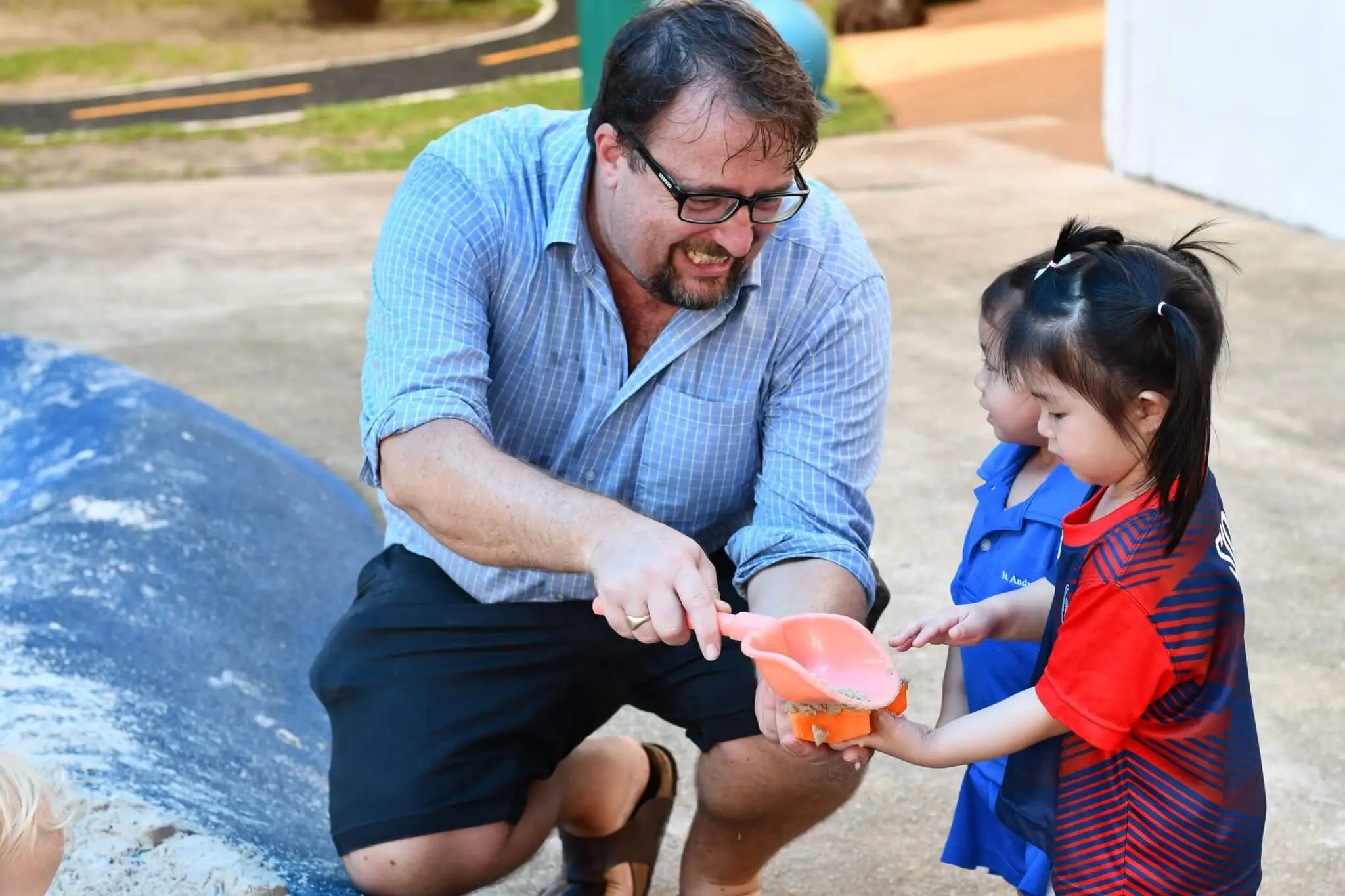
A common misunderstanding about outdoor learning is that it simply means releasing children into a natural space and stepping back to watch. In practice, the outdoor sessions that produce the most learning tend to blend genuine child-led exploration with purposeful, well-timed adult support.
This looks less like instruction and more like attentive company. A teacher outdoors is usually doing several things at once: noticing what has caught a particular child’s attention, introducing a relevant word or idea at the moment it becomes useful, offering a tool or material that deepens whatever a child is already investigating and recognising when to let a spontaneous discovery run its course rather than pulling the group back to the original lesson plan.
This balance is deliberate. Child-led exploration still benefits from attentive observation and timely adult support, so it is rarely left entirely alone. Direct every moment too tightly, on the other hand, and the outdoor setting stops offering anything a classroom could not, since it becomes simply a relocated lesson rather than a different kind of learning altogether.
Building environmental awareness through direct experience
Sustainability is often taught through posters, statistics and slides, which can make it feel distant and abstract, particularly to younger children who have not yet developed a strong sense of scale or long-term consequence. Direct contact with living things offers a different route into the same ideas. A child who has watched a seedling grow, or noticed which insects visit a flowering plant, is building an understanding of ecosystems that starts from observation rather than instruction.
This principle underpins nature-based education programmes around the world. In Qatar, for instance, the Earthna Center’s work with schools, recognised by UNESCO, is built on the idea that hands-on contact with local ecosystems, coastal habitats in that case, fosters a deeper environmental understanding than material taught purely through explanation.
The same logic applies closer to home. Composting food waste, keeping a worm farm or tending a school garden turns waste, soil and growth into something children handle rather than read about, which is part of why many international schools now pursue Eco-Schools status and build sustainability work into daily school life rather than treating it as a topic for one week a year. The details of any individual programme will vary by school and by country, but the underlying logic holds fairly widely: children develop a more durable sense of environmental responsibility when they have had the chance to notice growth, decay and change first-hand, rather than only reading about it.
How outdoor learning grows with children
The evidence base for outdoor learning is strongest for early years and primary-age children, which is where the deepest section of this article has been focused. That does not mean its value disappears as children get older. Research on curriculum progression in outdoor education frames the shift from early years through to secondary school not as a single fixed programme but as a gradual evolution, one that involves more independence, greater complexity and a wider variety of settings as children mature.
In the early years, this typically looks like sensory exploration, loose parts play and simple, closely supervised contact with living things, such as watering a plant or watching insects. Through primary school, this tends to shift towards more structured investigation: garden-based science projects, weather recording over time and collaborative studies of a local habitat, where children start to apply outdoor observation to specific curriculum questions. Residential trips, which at many schools begin around Year 3, add another layer by asking children to manage themselves away from home. By secondary school, outdoor learning generally takes a more independent and self-directed form, including environmental fieldwork, data collection and sustainability projects that draw on the planning, communication and risk-management skills first developed through much simpler outdoor play years earlier.
A study of lower secondary students’ experience of using school grounds as a learning environment found that older students engaged meaningfully with outdoor lessons when the activity involved genuine investigation, rather than a straightforward relocation of ordinary classroom content outside. That finding echoes a point worth repeating at every stage: what makes outdoor learning valuable is not novelty or fresh air on their own, but purposeful design that gives children a real reason to be outside.
What parents should look for
For families evaluating a school’s outdoor provision, particularly when comparing options between international schools, a handful of practical questions can help distinguish outdoor space that is genuinely woven into learning from outdoor space used mainly for breaks and free play.
- Is the outdoor space used regularly for structured learning, or mostly during break and free-play time?
- Does the space support academic and cognitive learning as well as physical activity?
- Are children given genuine choices about what to investigate, rather than following one fixed activity?
- How does the school distinguish between manageable challenge and genuine hazard, and how is that balance managed day to day?
- Are natural, open-ended materials part of the space, alongside any fixed play equipment?
- Do outdoor experiences connect explicitly to what is happening in the classroom?
- For schools in hot or humid climates, how has the outdoor space been adapted for shade, drainage and year-round use?
None of these questions require a school to have elaborate grounds. A small planting bed, a shaded gathering area or a well-stocked box of loose natural materials can all support meaningful learning, provided they are used with intention rather than left as scenery. The scale of a school’s outdoor facilities matters far less than how deliberately those facilities are put to work.
Bringing it back inside
Outdoor space is not a decorative extra on a school campus, and it is not simply somewhere for children to burn off energy between lessons. Used thoughtfully and connected explicitly to what happens in the classroom, it gives children direct, sensory contact with ideas that would otherwise stay abstract: growth, risk, cause and effect, collaboration, patience. That kind of first-hand experience tends to build curiosity, confidence, careful observation and a sense of responsibility, not because time outside is inherently good for children, though it generally is, but because of how thoughtfully that time is designed and used.
If you would like to learn more about the educational experience at St. Andrews International School S107, you can explore our campus and facilities or arrange a visit to see how our outdoor and indoor spaces are used day to day. We would be glad to welcome you.